
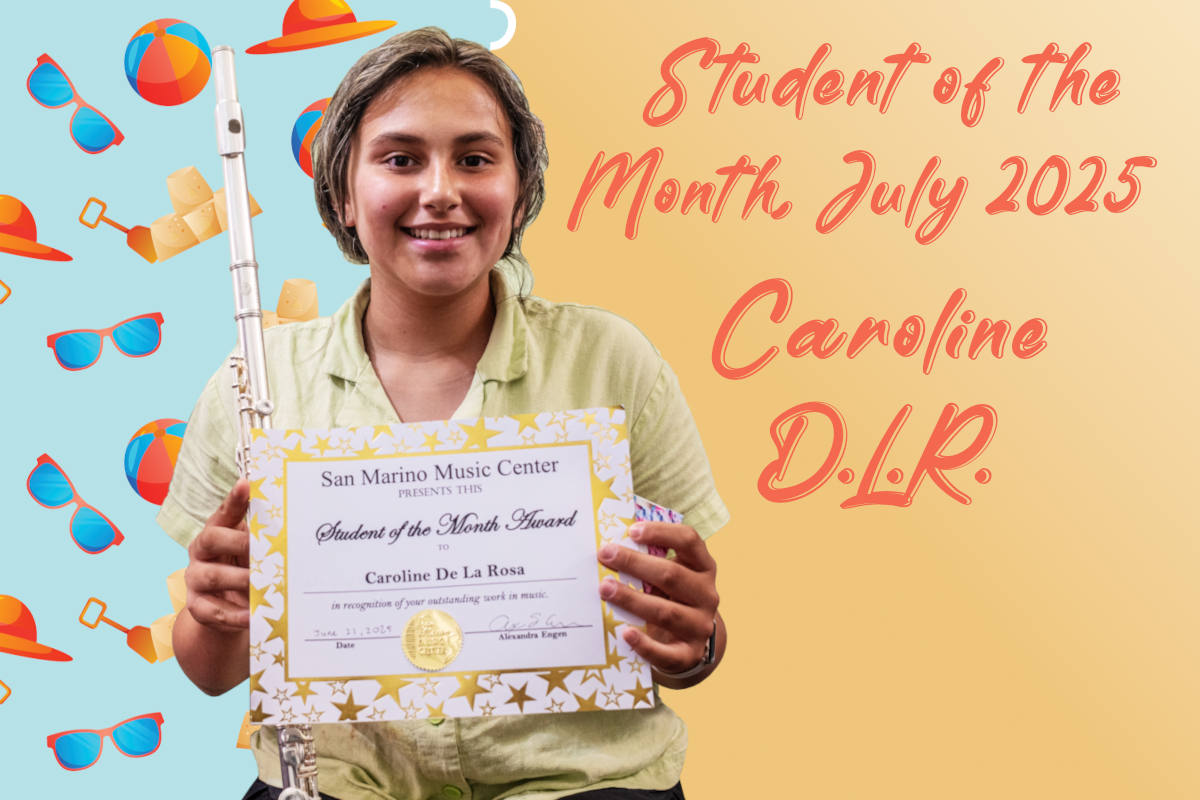
Congratulations to Caroline D.L.R.
Flute has a very recognizable look and a sound that is easily discernible. It is bright, clear and high pitched. The flute cuts through the sound of the other instruments in a band or orchestra. It can be played to evoke many different types of feelings. I can be played majestically as in Rossini’s “William Tell Overture” flute excerpt. It can evoke mystery and fantasy as in Debussy’s Prélude à l’après-midi d’un faune. The flute can also be played fancifully and lighthearted as in excerpts from Mozart’s “The Magic Flute”.

The instrument is constructed in 3 parts. They include the head joint, the middle joint and the foot joint. The head joint has the embouchure hole and the lip plate attached to it. It can be a challenge for a beginner to learn to make a good sound. To start, a flutist positions their lower lip on the lip plate so that it covers the lower third of the embouchure hole. With the lips slightly split apart, the player blows air over the hole to the opposite edge. From here, the beginner needs to adjust the orientation of the head joint until you find the position where a good, consistent sound can be produced.
Making A Sound
Often, beginner students will learn to play the flute by practicing to make a sound on the head joint by itself. Developing an embouchure is key to learning to play a wind instrument. Embouchure is how a musician their mouth, lips and facial muscles to blow air into or over a mouthpiece. For the flute, it is done in a few key steps:
- Tighten your lips at the edges as if you’ve tasted a very tart grapefruit.
- Take a deep breath.
- Open your tight lips as if to say the word “too” and blow the air out.
- Place the head joint to your lips as explained earlier and find the position where a consistent sound is produced.
As you can clearly see, it takes time and practice to develop the embouchure necessary to be able to play the instrument. Since everyone’s lips and facial muscles are unique, everyone’s embouchure technique will vary slightly. Those who stick with it and develop are on their way to make beautiful music with the flute.
In Her Teachers Words

Caroline has been taking music lessons at SMMC since November 2023. Caroline started as a complete beginner and next month will be auditioning for the Los Angeles Youth Orchestra. Currently, Caroline studies with Ms. Alexandra Engen. Alexandra holds a Master of Music in Flute Performance from New York University and a Bachelor of Arts in Flute Performance from the University of California at Davis. Ms. Alexandra writes:
“Caroline De La Rosa comes to lessons excited about her flute abilities. Improving her abilities is always top of mind for her! She has a proactive approach to technical development, allowing her to consistently build her toolkit of various flute techniques. This includes some more advanced abilities, such as flutter-tongue and vibrato. Caroline’s duet performance at the recent SMMC recital showcased not only her flute skills but also her growth in confidence, which is the most fulfilling part of teaching. It’s always a joy having Caroline in lessons and helping her develop into a strong performing flutist.”
Well done Caroline! Indeed, your performance at SMMC’s spring recital was a wonderful showcase of your talent and hard work. We cannot wait for the next time you perform at one of our events.
Caroline’s Recital Performance
And right on cue, here is Caroline performing a flute duet with her instructor, Ms. Alexandra.
In Her Own Words
Time for the “Q & A” portion of our blog! We asked Caroline to answer a few questions for us so we can learn a bit more about the this young flute phenom. Here is what Caroline had to say:
1. How long have you been playing music? What do you like most about it?
“I have been playing my instrument for 2.5 years. What I like most about playing it are the sounds and beautiful noises it makes as I play.”
2. Why did you start playing flute? Why did you decide to take lessons?
“When I was a six, I was in a instrument store and I saw the flute. I asked if I was old enough to play it and the person there answered “no”. They said I should be at least 8 years old to play. When I turned ten, I was definitely old enough to start playing. I also started taking lessons and I loved them.”
3. What do you like about how your instrument sounds and is there anything that makes your instrument special?
“I like how the flute makes graceful, beautiful sounds. I also like it is not a well known instrument. People usually get it mixed up with the clarinet.”
4. What is your favorite food, movie/tv show, video game, etc.?
“Food: salad. Movie: Wicked. Video Game: Roblox.”
5. Besides music, what do you like to do in your free time?
“Be with and pet my cat , read, and ride my scooter.”
6. What have you done this year that you consider to be the most fun you’ve had all year?
“Just being with my friends and having quality time hanging out with them as we get ready for the next school year. We comfort each other when needed and like playing games together, or just try to have fun,”
Thank you for sharing Caroline! Congratulations from everyone at SMMC on the award.
Meet The Instructor
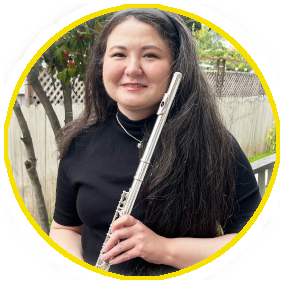
Alexandra Tseng Engen-a classically trained flutist & composer from South Pasadena, California. Alexandra earned a BA for Flute Performance from the University of California, Davis. She performed extensively with the UC Davis Symphony Orchestra (UCDSO). She completed her Bachelor of Arts degree from UC Davis with a double emphases in Flute Performance and Honors Composition in 2011. Alexandra went on to obtain her Master of Music (M.M.) degree in Flute Performance from New York University: Steinhardt in 2014. Alexandra is a flexible and supportive instructor that likes to make music a fun experience for her students.